Fine Bubble Tube Diffusers
Step into the biological tank of a wastewater treatment plant and look down through the churning surface: rows of long, bar-shaped devices sit neatly on the tank floor, steadily releasing streams of fine bubbles — making the whole basin look like a boiling pot of water. These devices are Fine Bubble Tube Diffusers. They may look unassuming, but they are the "oxygen heart" of the entire biological treatment system: whether aerobic microorganisms work efficiently, whether energy consumption is high or low, and whether piping clogs — all of it depends on these "bubble tubes." Today, drawing on the technical introductions of international brand SSI Aeration and Chinese manufacturer wxholly, let's lift the scientific veil on this equipment.
1. Aeration: The Most Energy-Hungry Step in Wastewater Treatment
In municipal sewage and industrial wastewater treatment, aerobic biological treatment (activated sludge, MBBR/IFAS, etc.) is the core process, and aerobic microorganisms "breathe" with oxygen. The aeration system shoulders two tasks:
However, the aeration system typically accounts for 50%–70% of a treatment plant's total electricity consumption. Every gain in oxygen transfer efficiency (SOTE) translates directly into significant electricity savings — which is precisely why fine bubble aeration technology has long been a focus of attention.
2. Why Are "Fine Bubbles" More Efficient Than "Coarse Bubbles"?
The smaller the bubble, the higher the oxygen transfer efficiency — this is the golden rule of aeration. The reason lies in gas-liquid contact area:
That is why modern diffusers use advanced membrane perforation technology to machine ultra-fine pores or slits (commonly 1mm or 2mm) into the membrane, producing micro-bubbles of only 1–3mm diameter — achieving far higher oxygen utilization than coarse bubble aeration.

wxholly fine bubble tube diffuser in operation in a pond: the entire tube emits a full, uniform curtain of fine bubbles — the fineness and evenness are visible to the naked eye.

wxholly tube diffusers installed in a large aeration tank: main headers + lateral branches + evenly arranged diffuser arrays form a complete air-distribution grid.
3. Tube vs. Disc: Why Choose "Tube"?
Aeration diffusers mainly come in two forms: disc and tube. Compared with disc diffusers, tube diffusers offer distinct advantages:
4. Core Technology Dissected: Membrane, Support and Anti-Clogging Design
The performance of a fine bubble tube diffuser depends mainly on three technical pillars:
1. Membrane Material: Determines Service Life and Fouling Resistance
The membrane is where bubbles are "born," and its material directly determines performance:
wxholly uses imported raw materials and emphasizes long-term flexibility, good chemical stability, no plasticizers, acid/alkali resistance, no hardening, no brittleness, and no aging — properties that directly determine whether the membrane pores stay open and un-caked after years of service. SSI, meanwhile, manufactures membranes with a compression molding process and equips each cavity with an individual thermocouple for 100% quality control, balancing low plasticizer content (to avoid shrinkage and hardening) with just enough to prevent creep.
2. Support Pipe Structure: Determines Bubble Uniformity
This is SSI's patented highlight. Traditional diffusers use round pipe supports: when the membrane inflates, its inner wall clings to the round pipe, obstructing air passage. SSI's Channel Pipe features small air pathways running the full length of the support pipe, so air travels all the way to the end of the diffuser — creating a uniform bubble pattern along the entire length. The channel structure also resists folding/tearing, the membrane fits snugly without creasing, and a built-in step on the support pipe prevents the membrane from sliding over time.
3. Anti-Clogging and Maintenance-Free Design
The number-one enemy of fine bubble aeration is clogging: when sludge enters the micro-pores and dries, the bubbles stop coming. Quality products avoid this through:

5. Applications: From Wastewater Plants to Fish Ponds
(1) Fine bubble tube diffusers serve far more than municipal sewage:
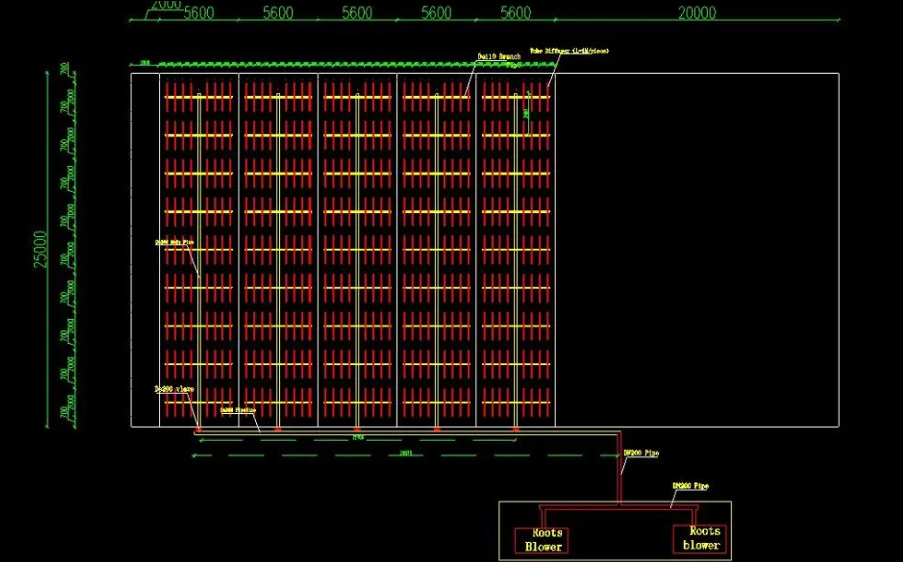
- wxholly aeration system CAD design: DN200 main pipes, De110 branch pipes, tube diffusers (L=1m/pc) and Roots blowers in a complete configuration.
6. MBBR/IFAS Upgrade: A "Capacity Multiplier" for Old Tanks
We also highlights an important trend: using fine bubble tube diffusers together with biofilm media to upgrade conventional activated sludge systems into IFAS or MBBR processes. The benefits:
Tube diffusers are ideal for this upgrade path precisely because they distribute air evenly and can be flexibly arranged on existing tank floors — creating the ideal fluidization regime for suspended biofilm media.
Wuxi, China, fine bubble tube diffusers play the same role across different markets and processes — an efficient, reliable, energy-saving cornerstone of oxygen supply. Hidden at the bottom of aeration tanks, they quietly hold up the efficiency and vitality of the entire biological treatment system with rows of fine bubble columns.
For operators, choosing the right diffuser means installing a long-lasting, high-efficiency underwater respirator for the treatment plant or fish pond.
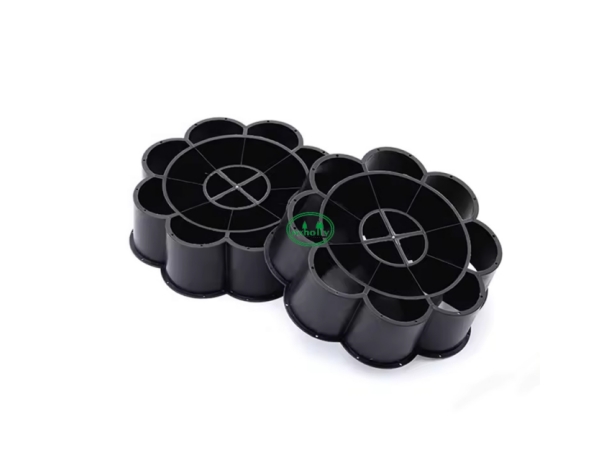
Fill Pac Media
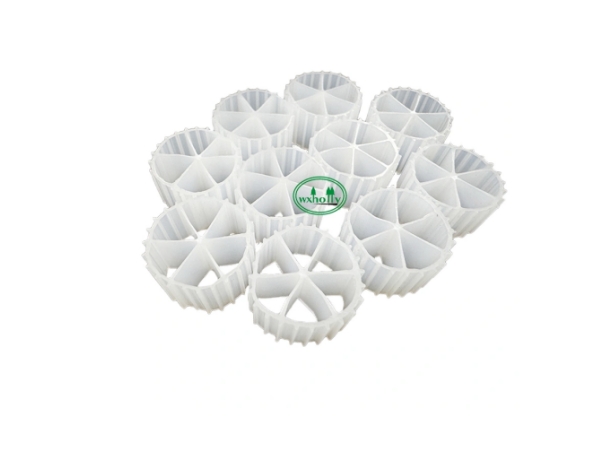
MBBR Bio Media
Related Article